The landing page builder that writes a different page for every ad angle
Describe the page in chat and it is built as typed blocks, not HTML. Each variant matches on your URL parameters, so a click that promised same-day never lands on the page about price. After that, the traffic split tunes itself.
Free forever once you add your Claude API key. Every limit is listed further down this page.
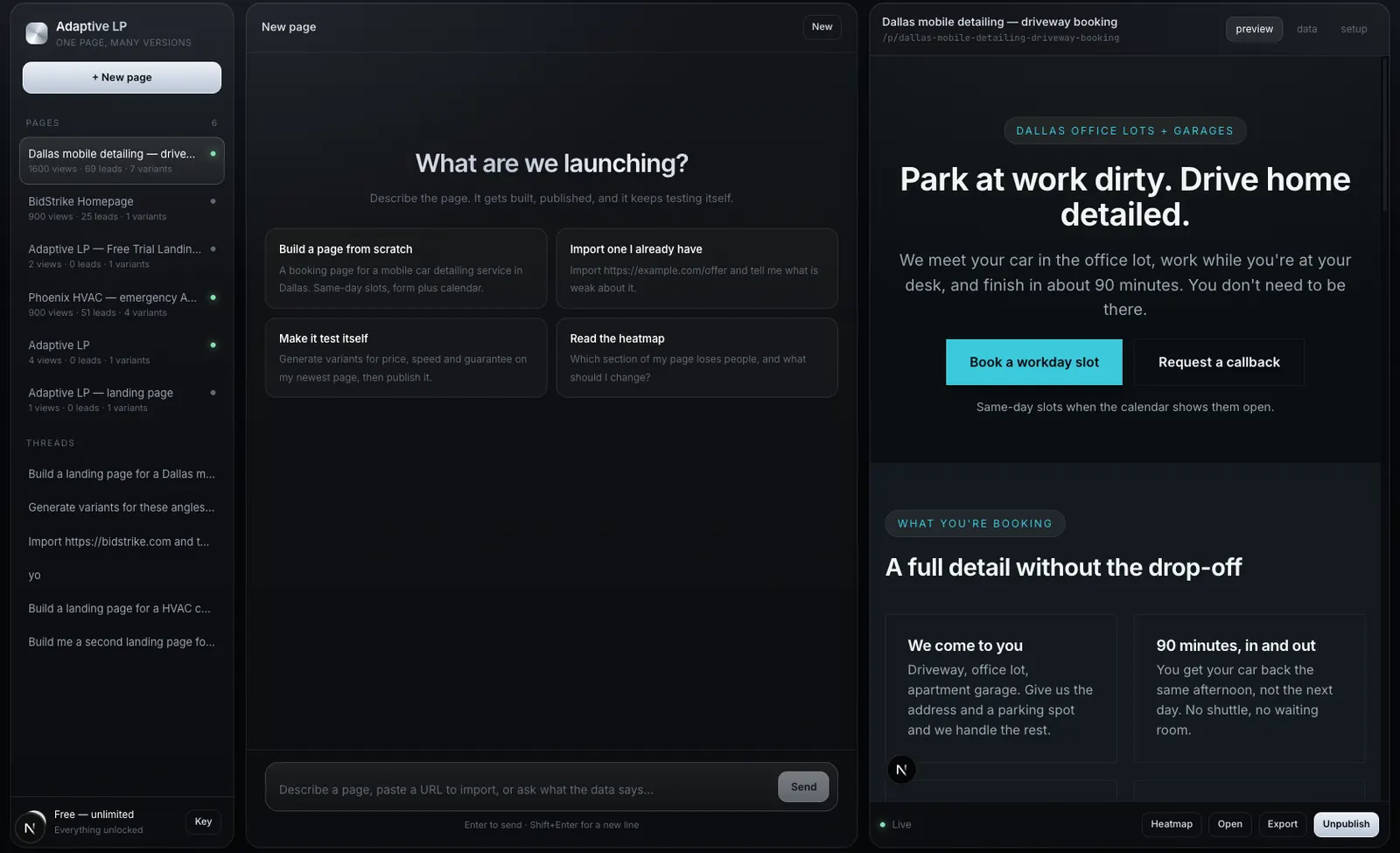
One page, five ad angles, four broken promises
You are paying for every click. The page only answers one of them.
The click already made a promise
Your cheapest ad and your fastest ad send people to identical copy. One of those visitors read a promise the page never repeats. They leave, and the platform charged you the same for them.
Message match is most of the work
A dynamic landing page says back what the ad said, in the same words and the same order. Skip that and nothing further down the page saves the visit.
This is not only a Google Ads problem
Email, SMS, TikTok, a QR code on a flyer. Anything that can carry a URL parameter can carry its own version of the page, and right now they all share one.
How the AI landing page builder works
No code, and no drag and drop either. You type what you want and read what it changed.
Describe the page
Give it your website and your offer. It reads the real palette and typeface off your site, then writes the page as typed blocks. Building a complete page costs about 35 cents of model usage.
Name your angles
Cheapest, fastest, guarantee, whatever your ads actually promise. It writes a variant for each one, overriding only the blocks that need to change and leaving the master copy as the source of truth.
Route it, then publish
Each variant gets a URL parameter rule, so the ad, the email segment or the QR code decides which version is allowed to appear. Publishing is a flag, so it is live the moment you say so.
Configuration is one tab, not a settings maze

Build, set up and data
Three tabs on the same page. Set up holds the whole configuration for that page, and nothing is buried two levels down.
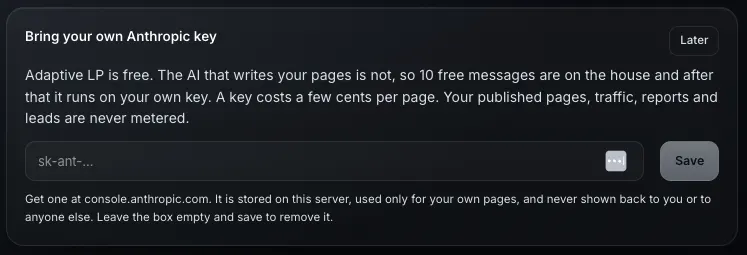
Your own Claude key
Paste your Anthropic API key and the builder runs on your account. Writing pages is the only thing that spends it.
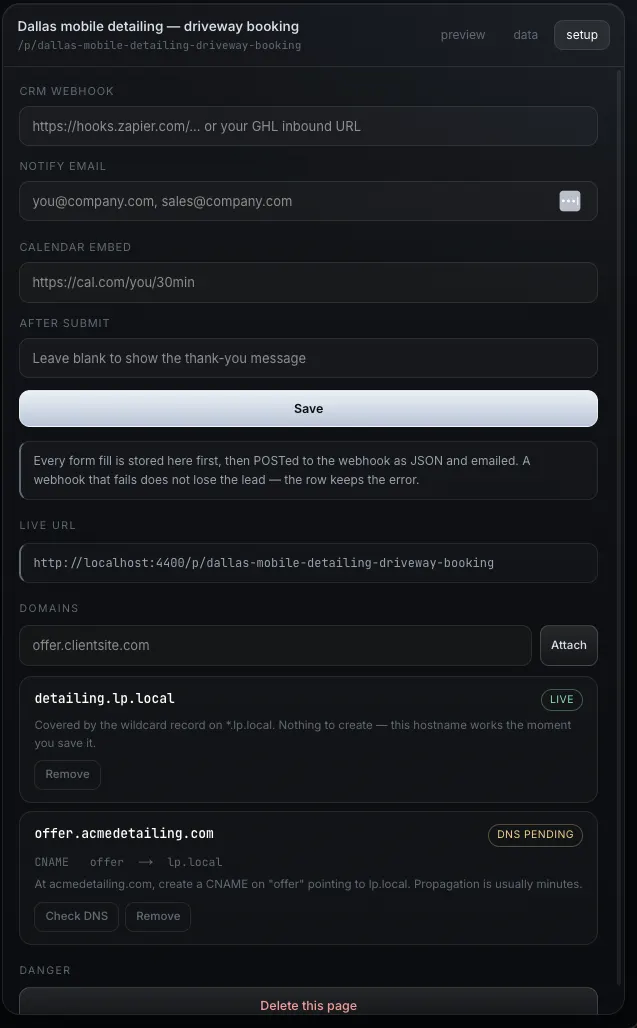
Leads go where you already work
CRM webhook, notification email, calendar embed, after-submit redirect, live URL and custom domain in one section. Fills are stored here as well, so a wrong webhook never loses a lead.
Landing page personalization without a second page to maintain
One page, many versions, one place to edit.
Blocks are why this works at all
The page is stored as a typed block array rather than markup. That is what lets a single section be rewritten for one audience while every other section stays shared.
Intent decides, then statistics decide
A variant with a match rule is served only to traffic carrying that parameter, and withheld from everyone else. Inside whatever pool is left, the optimizer picks freely. Your same-day ad can never be answered with the price page because price converts better on average.
A/B testing that does not stall
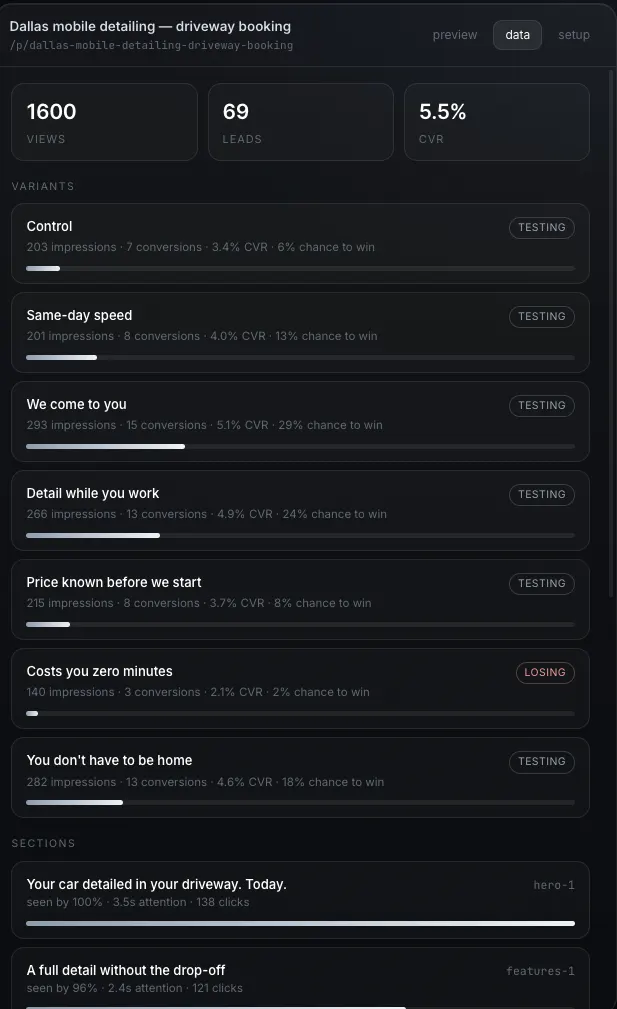
Thompson sampling instead of a fixed split. Every new version gets 100 guaranteed impressions before it can be judged, no version takes more than 80 percent of traffic, and a visitor stays on the version they first saw.
Analytics that name the section where you lost them

Data is a tab on the page
Switch to data on any page for date ranges, comparison against the previous period, and CSV export of the whole thing.
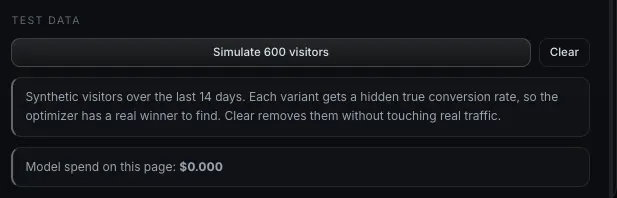
Try it before you have traffic
Send simulated visitors through a page to see the funnel, the heatmap and the version results fill in. The numbers are labelled as simulated so nobody mistakes them for real.
A funnel of people, not pageviews
Unique-people funnel that names the biggest drop-off outright, sources credited to a visitor's first view, devices, scroll depth, section attention and per-version results.
What it costs to run
Why the thousandth page costs the same as the first
Publishing flips a flag on a record. There is no build step and no deploy queue, so page one thousand goes live as fast as page one.
Choosing which version a visitor sees is arithmetic on stored counts, not a model call. Traffic does not spend AI credit. The only thing that costs money is the writing, and you write a page once.
A builder should not cost more than the ads it serves. That is the part this gets right.
What it does not do yet
New tool. This is the list you would find out in week two anyway.
No real traffic has run through it
Every mechanism here is built and tested. None of it has been proven against a live audience, which is why there is no lift percentage on this page, no customer count and nobody quoted.
Under about 2,000 visits a month it resolves slowly
The optimizer needs volume to separate versions with any confidence. Below that, the value is build speed, message matching and section analytics, and those work at any traffic level.
It does not read your ads
It will not log into Meta or Google and pull your angles out for you. You name the angles. Matching runs off URL parameters you set on your own links.
There is no drag and drop
No visual editor, no pixel control. Editing is conversational and the block types are fixed. You get a consistent layout and you give up moving things by hand.
No session replay
You get scroll depth, section attention and heatmaps. You do not get video of individual sessions, and nothing here reconstructs one.
Import quality varies
It can pull an existing page in and turn it into blocks, but layout is not preserved and JavaScript-rendered pages come back with almost nothing in them.
Questions people ask before they build one
Is this free?
Yes, free forever. Add your own Anthropic API key and Pagetive is yours to use, with no page limit and no card. Writing a page costs roughly 35 cents of model usage on your key. Serving pages, traffic, reports and leads cost nothing.
Does it work as a landing page for Google Ads?
That is the main case it was built for. Put utm_content on each ad, give the matching version the same rule, and which headline to keep stops being a guess.
What about SEO?
Pages render as real HTML with a title and description you control, on your own domain if you attach one. It is built for paid clicks first, so treat organic traffic as a bonus rather than the plan.
Can I use my own domain?
Yes. Attach a subdomain of yours or a client's own hostname and it hands back the exact DNS record to create.
Where do the leads go?
Stored in the app, POSTed to your CRM webhook, and emailed to you if you set a notification address. A wrong webhook does not lose the lead.
Can I take the page with me?
Yes. Export it as one self-contained HTML file and host it anywhere. The form on the exported copy still posts leads back here.
Start building
Tell us what you are running traffic on. You will get straight into the builder.
Free forever, on your own key
Pagetive costs nothing to use. Paste your Anthropic API key and build as many pages as you want. The page you are on was built by the product and is served by the product, so it gets variants, a funnel and heatmaps exactly like any page you would make with it.
No card and no page limit. Limitations included above.